Connecting What Is Already Here
The common instinct in school development is addition. When a new challenge appears or a fresh educational trend emerges, the immediate reflex is often to introduce another programme, schedule another workshop, or set up another committee. Over time, even the most well-intentioned schools can end up with a crowded landscape of good ideas running in parallel, each competing for the limited hours and energy of teachers and students.
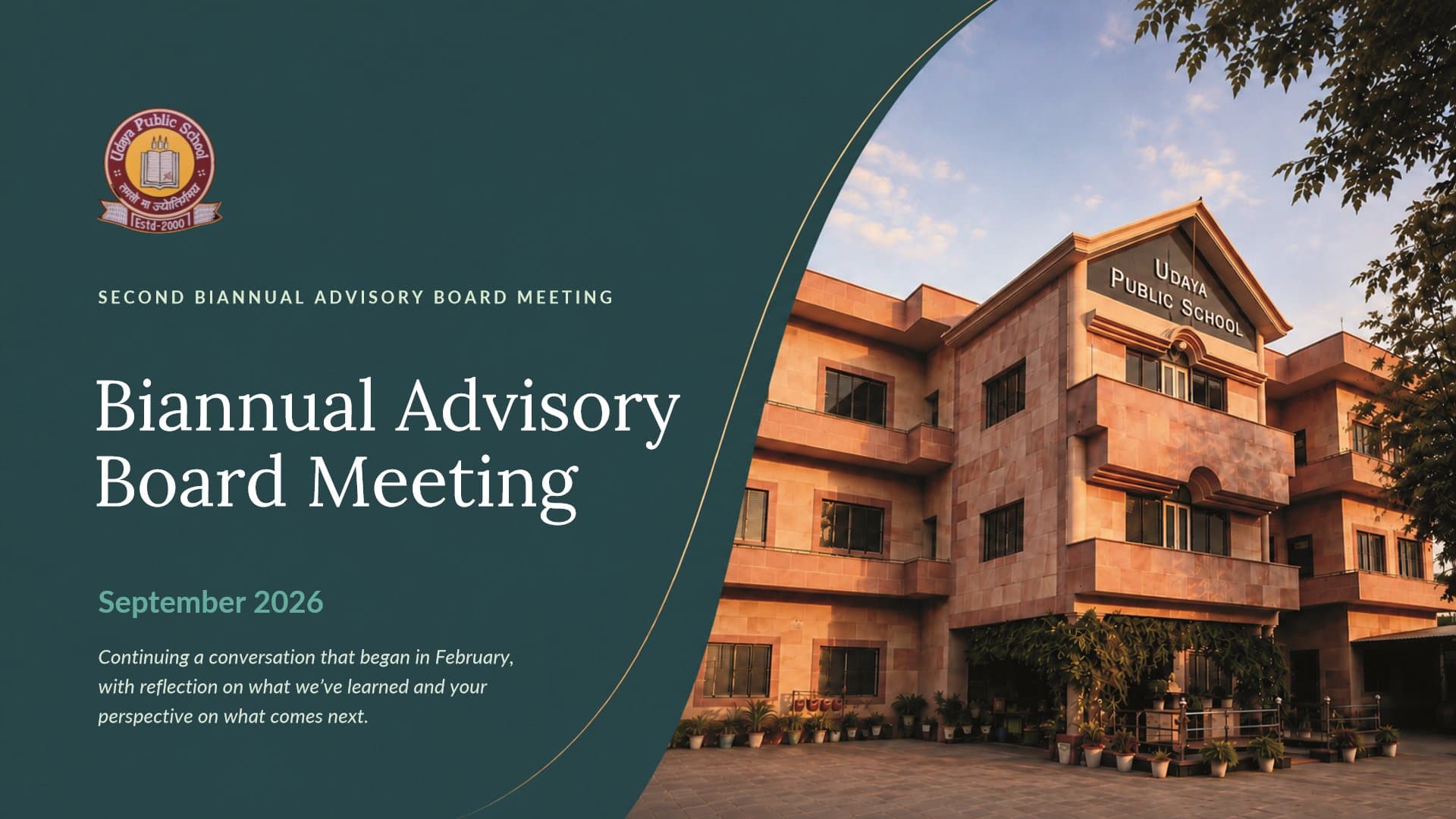
When our Advisory Board gathered in September 2026 to review the school's ongoing work, the conversation arrived at a different, quieter insight. The next phase for Udaya Public School is not necessarily about adding more. It is about connecting what is already here a little more thoughtfully.
The meeting provided an opportunity to look closely at our existing initiatives in wellbeing, student leadership, technology, and academic support. What emerged was a collective desire to move away from treating school improvement as a checklist of separate projects, and instead focus on how these efforts speak to one another in the daily life of our classrooms and corridors.
Unifying Wellbeing with Academic Reality
In recent terms, the school has put dedicated effort into student care through our School Counsellor, the Safe Voice platform, and our Social and Emotional Learning (SEL) handbooks. The Board noted that while each of these strands is valuable, they currently operate in relative isolation.
There is an obvious opportunity to bring them into dialogue. What the Counsellor and Safe Voice learn about students' everyday worries can directly inform what goes into our SEL handbooks, ensuring our guidance is rooted in real student experiences rather than generalised assumptions. Similarly, students could use Safe Voice to give feedback on the handbooks themselves, giving the platform another practical role without requiring the school to create a separate feedback channel.
Equally important was the Board's observation that emotional wellbeing cannot be neatly separated from academics. For our senior students, particularly in Class XII, personal stress is often tied directly to academic pressures, subject choices, career questions, and the uncertainties of what comes after school. Expanding Safe Voice so students can raise academic and future-planning concerns allows the school to respond to their worries as a whole, rather than treating emotional health and academic progress as entirely separate domains.
This insight also reinforces the need to link the skill-building and career exploration taking place across high school. When students have structured opportunities to explore varied interests early on, deciding what to study after Class XII feels far less abrupt.
Starting with Curiosity in Emerging Technologies
The discussion turned naturally to emerging subject areas, particularly our work in Robotics and newer creative technologies such as Vibe Coding. Here, the Board recommended a grounded, exploratory approach: start with the basics.
Before students are introduced to complex frameworks or advanced project goals, they need time to grow comfortable with fundamental principles. The primary aim of an initial encounter with Robotics or coding should be curiosity and open exploration, kept deliberately low-pressure. Students should never feel that an emerging field has simply become another heavy academic syllabus dropped onto their desks. More structured and demanding learning can follow naturally once that initial comfort and excitement have taken root.
Alongside curricular design, the Board gave careful attention to financial sustainability. The current investment in Robotics will eventually conclude, and project funding will shift. The Board urged us to think beyond isolated investments and ask fundamental questions about institutional durability: what can the school realistically fund from its own resources, what will require outside support, and what should be prioritised first?
While the school is currently exploring what grant proposals might look like to support some of these ideas, no outside funding has been secured, and no proposal has been finalised. Financial planning must sit alongside every pedagogical decision so that promising work does not stall when an initial project budget ends.
Reimagining the Student Council Experience
Student leadership is another area where the Board encouraged deeper reflection. Our Student Council members already give substantial time to organising school events, assisting with day-to-day routines, shortlisting articles, and coordinating workshops. These contributions keep the school running smoothly, but our observations show that student interest does not always hold, and genuine ownership can fade over the course of an academic term.
The Board posed a constructive challenge: how can student council responsibilities become more educational and personally meaningful? Moving beyond purely administrative duties requires placing greater trust in students, giving them authentic room to make decisions, and offering them more chances to learn through direct action. One promising idea raised was to facilitate connections between our Student Council and councils in other schools, allowing our student leaders to observe different leadership styles, exchange ideas, and reflect on their own roles.
Capacity, Workload, and Honest Evaluation
Underlying all these reflections was an essential operational truth: every new initiative asks something of the people running it, particularly our teachers and School Counsellor.
Before introducing any new effort, the school must realistically evaluate the time required, the counselling caseload involved, and the level of teacher engagement needed to sustain it. This is not an argument against ambition; rather, it is a sensible framework for deciding how large or small an initiative should start, and what support it requires to remain healthy over time.
To guide this work, the Board suggested organising our ongoing priorities into a small set of overarching themes, including Class XII academic outcomes, evolving technological needs in AI and Robotics, student and teacher mental wellbeing, cultural initiatives, student voice, and school systems. For every theme, the school needs a clear view of what is being invested, what it is intended to achieve, what teachers and students actually gain, and whether those gains justify the resources involved.
That requires asking honest questions rather than making comfortable assumptions. Through our SEL materials and beyond, we need to know how frequently resources are actually used, which practices are having a genuine impact, which materials need a refresh, and which initiatives may not need to continue at all.
Looking Ahead
As we carry these reflections forward into the remainder of the academic year, the task before us is one of deliberate cultivation. Our aim is to ensure that wellbeing and reflective learning do not remain confined to one-off events or occasional workshops, but become part of the natural rhythm of everyday life at Udaya Public School.
Whether through closer day-to-day collaboration between teachers and our Counsellor, creating structured listening spaces where students feel safe speaking openly, or tending to emerging institutional efforts like our kitchen garden and data privacy practices, the guiding principle remains consistent. We are committed to listening carefully to our students and teachers, measuring our capacity honestly, and strengthening the connections that make our educational community whole.