
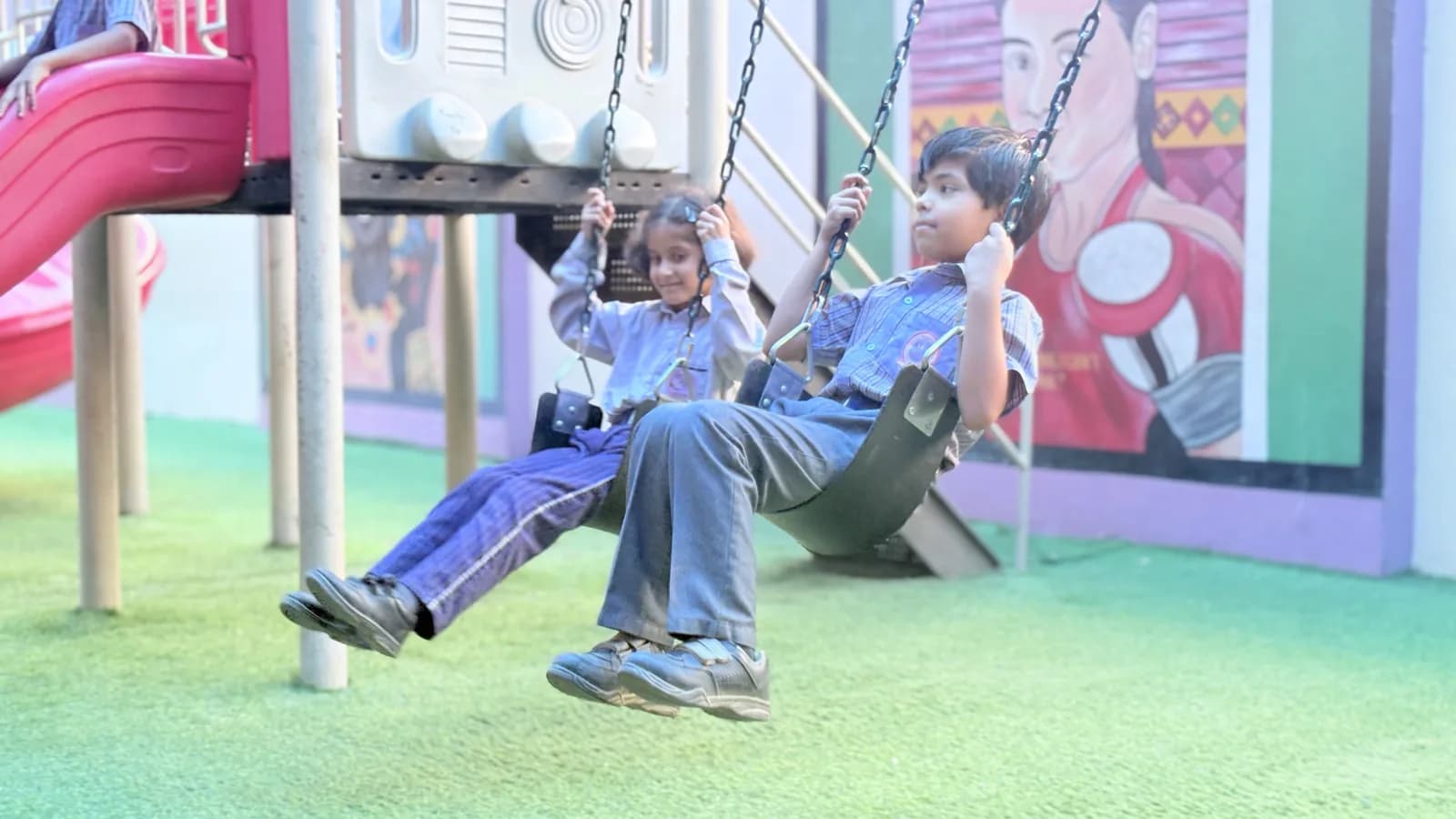
Ask a four-year-old what they did at school and you will rarely hear about the alphabet. You will hear that they went very high on the swing.
This is not a failure of the curriculum. At that age, finding out what your body can do is the curriculum — and it is the part that the rest is built on. So the largest thing we have built for our youngest children this year is a place to run about in.
What We Built
Our second modern playground has opened at UPS Kids, for our Nursery, LKG and UKG children. It has:
- Artificial turf across the whole surface
- A roof over the play area
- A large slide set
- Swings
- A merry-go-round
- A tunnel
- See-saws
- A half-dome climbing frame
The first of our two playgrounds was built a few years ago in Block D, for Classes 1 to 3. This one is designed around children several years younger, which changes almost everything about the equipment: lower heights, wider platforms, more to crawl through and hold on to.
Why the Roof Matters More Than It Sounds
Of everything on that list, the roof is the piece we would draw a parent's attention to.
An uncovered playground in Ayodhya is unusable for a large part of the year. It is too hot through the long summer afternoons, and it is unavailable for weeks during the monsoon. A playground that a child can only use in comfortable weather is a playground they use for a few months.
Covering it turns outdoor play from a seasonal treat into an ordinary part of the day. Combined with the turf, which stays even and does not turn to mud, it means the youngest children can be outside in almost any weather — which is precisely the point.
What Running Around Is Actually Doing
There is a temptation, once children are in uniform, to treat play as the reward for the real work. At three and four years old, that has it backwards.
Climbing teaches a child to judge distance and commit to a decision. A see-saw teaches them that their weight does something to another person. A tunnel is a lesson in spatial reasoning that no worksheet delivers. Swinging builds the balance system that later sits underneath handwriting and sitting still. And falling over on turf, getting up, and going again is how a small person learns that difficulty is survivable.
Children of this age also negotiate almost entirely through play — whose turn it is, how long a turn lasts, who goes first. A playground is where a great deal of the social work of a nursery year quietly happens.
Why We Spent the Money Here
We could have spent this on something more visible to visitors. We built a playground instead, because the case for it is straightforward: these are the youngest children in our care, this is the stage at which their bodies and confidence are forming fastest, and giving them the best possible start is not something that can be postponed to a later class.
It is also, frankly, the part of school a four-year-old will remember.
If You Are Considering Nursery
Parents deciding on a first school are welcome to come and see it, and we would encourage it — a playground is one of the few things about a school you can genuinely assess by standing in it for ten minutes.
Our admissions page has the process and the fee structure for NLU, and you can contact the school office to arrange a visit. Come during the school day if you can. An empty playground tells you very little.
We will keep building in this direction. The two playgrounds are a start, not a finish.