
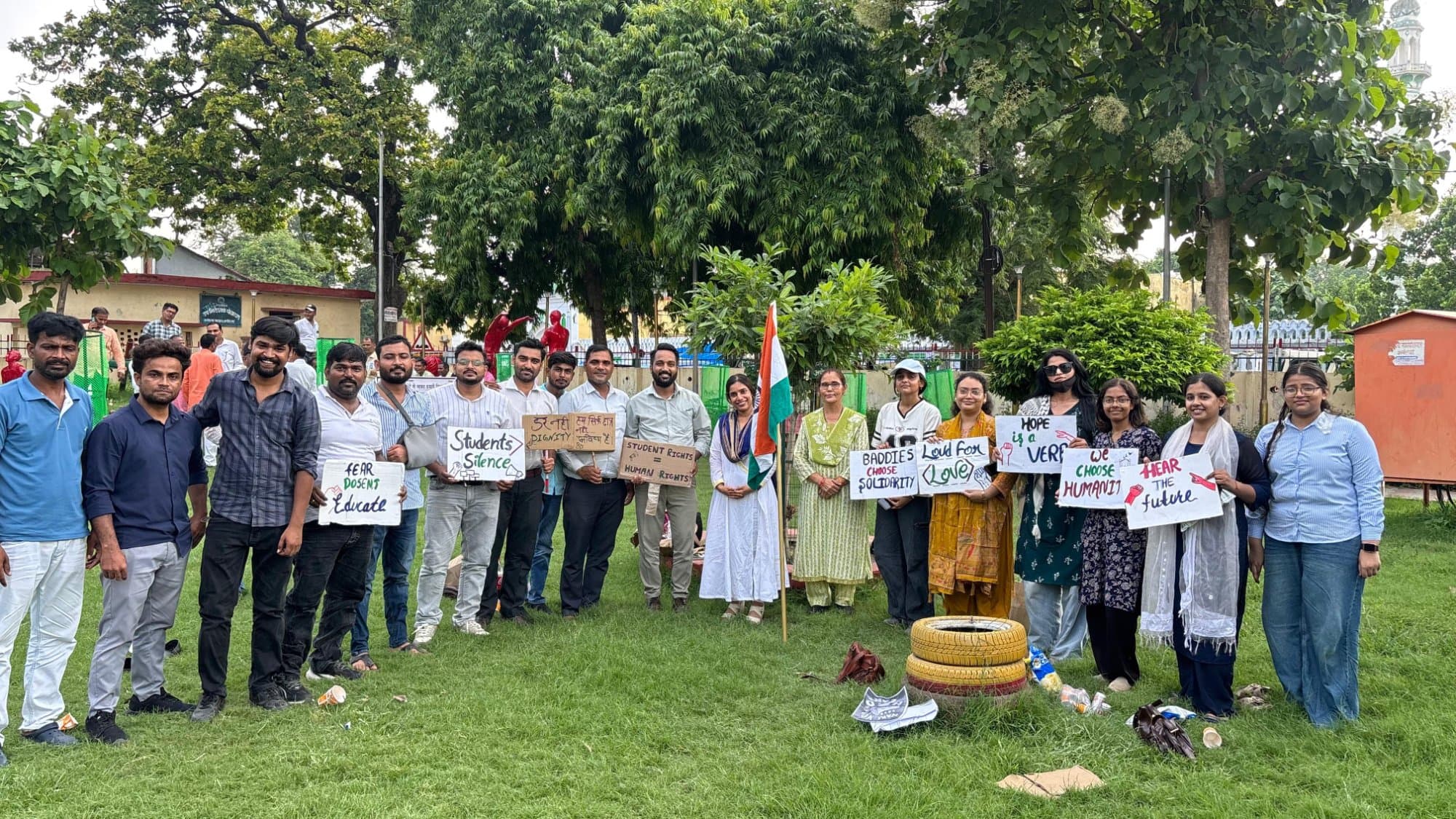
It all began with conversations. Every morning before work, the three of us found ourselves talking about student protests. Those conversations stayed with us long after the day had begun. We kept thinking about the students who had gathered to raise their voices, about how many of them felt unheard, and about the treatment they were receiving while asking for something as simple as being listened to. Like many others, we wanted to stand beside them.
The Journey to Organise Locally
There were moments when we genuinely thought about travelling to Delhi and joining the protest ourselves. But Delhi was nearly 700 kilometres away from Ayodhya, and as three young women, the decision was not as simple as booking a train ticket. Safety was a real concern. Our families were worried, and honestly, we were too.
Every day, we came across photographs and videos of women protesters being pushed, harassed and handled in ways that no one should ever experience. Those images stayed with us. Slowly, they turned into hesitation. We wanted to go, but fear kept finding reasons for us to stay back. That feeling was perhaps the hardest part. We weren't afraid because we didn't care. We were afraid because we cared deeply, but we weren't sure if we could keep ourselves safe. Living in a small city also shapes the way you think. Somewhere inside us lived the same questions that many girls grow up with. Is it safe? Should we go? What if something happens?
We are students ourselves. Two of us are pursuing a Bachelor's degree, another a Master's, and all three of us work in education. We believed that every student deserved to be heard and made to feel valued. That belief made it even harder to simply watch everything unfold from a distance. Then one day, we came across a call for district-level solidarity protests. Instead of asking people to travel to Delhi, it encouraged them to organise peaceful demonstrations in their own districts. For the first time, we felt that maybe we could do something.
Navigating Administrative Processes
Around the same time, we had also witnessed disturbing videos showing the brutality faced by protesting students. Watching young people being beaten and seeing women subjected to harassment left us angry and heartbroken. That anger became the push we needed. If we could not stand at Jantar Mantar, perhaps we could stand with those students from our own city. From the beginning, we knew one thing clearly. Whatever we did would remain completely peaceful and entirely within the constitutional framework. We simply wanted to exercise our democratic right responsibly. Since none of us had ever organised anything like this before, we had no idea where to begin.
We started researching the permission process, reading guidelines, drafting applications and even using AI tools to understand which authorities needed to be approached. Every step was new to us, but we kept learning as we went. Soon, applications were submitted. Phone calls began, waiting began, and with every passing hour, our hope grew. Unfortunately, our first request was rejected. We tried again through different channels, contacted more officials and explored every possible option we could think of. Every rejection was disappointing, but none of us wanted to stop there. Somewhere inside, we had already decided that we would at least try everything before accepting defeat. The evening before the protest, we finally found ourselves speaking with officials from the City Magistrate's office. We submitted our application again, explained the purpose of the protest and shared the proposed route from Hatti Mata Mandir to Gandhi Udyan.
The next morning, the three of us reached work, but none of us could concentrate on anything else. We kept calling the office, hoping for an update. We had already informed people about the protest. Posters had been prepared. Friends had agreed to join us. Everything depended on that one permission. After an hour, we were informed that permission had been denied due to security concerns. For a few moments, everything felt as though it had come to a halt. After days of planning, it was difficult to accept that the answer was simply "no". But instead of giving up, we requested a meeting with the City Magistrate. We were told that he was not in the office and that we would receive a call when he returned. We waited, and no call came. Finally, we looked at each other and said, "Let's just go." None of us had ever visited a court complex or a government office like that before. It was our first experience stepping into that world. As soon as we entered the court premises, one thing became impossible to ignore. Almost everyone there was a man. We could barely see any women.
As three young women walking through the corridors, we felt every eye turning towards us. Some people looked curious. Others simply stared, as though wondering why we were there. For a moment, it felt uncomfortable. Growing up, we had often heard that police stations and courts were not places where women belonged. Whether spoken directly or indirectly, those ideas stay with you. Standing there, surrounded almost entirely by men, we realised how deeply those messages had shaped our own fears. But strangely, that feeling didn't make us turn back. Instead, it reminded us why we had come. We were there to speak about our right to organise a peaceful protest. That thought gave us confidence.
Persistence and Permission
We searched for the City Magistrate's office, only to discover that he had not yet arrived. Other officials informed us that Saturdays were often quieter because many officers were away for other official duties. Rather than returning home, we asked if there was anything else we could do. An officer suggested that we submit another written request. This time, we proposed an alternative. If a protest march could not be permitted, would it be possible to simply sit peacefully in Gandhi Udyan for one hour? We believed this would remove concerns about traffic or public inconvenience. We submitted the revised application with hope, but within minutes, it was rejected.
For the first time that day, we felt genuinely defeated. We walked outside and sat silently on a bench, wondering what to do next. A woman sitting nearby noticed us and asked what had happened. When we explained everything, she smiled gently and told us that she had been visiting these offices for more than a year, trying to resolve her own matter. Government work, she said, often moves slowly. Her words didn't change our situation. But they reminded us that persistence matters. So we stood up once again. If one door had closed, we would knock on another. We decided to approach the District Magistrate's office next. By then, we had already heard "no" several times that day, but none of us felt ready to stop. When we reached the office, we learnt that because it was Thana Diwas, the District Magistrate was unavailable. We were advised that permission would be extremely difficult, especially with the restrictions that were in place.
Once again, it felt like we had reached another dead end. Fortunately, we knew someone who was familiar with the workings of the local administration. They suggested that although meeting the District Magistrate would be difficult, we could at least try speaking with the Personal Assistant. We did exactly that. The conversation was respectful, but the answer remained the same. We were told that permission would be difficult and that receiving it on the same day was almost impossible. Even then, we weren't ready to leave. We requested that our application be shared once again and waited outside, hoping that perhaps someone would reconsider. At one point, we stepped out to get another copy of our application printed. When we returned, we requested to meet the Personal Assistant again. An officer went inside to ask for permission and casually announced, “Dharne wali ladkiya aayi hai” (The protest girls are here).
Perhaps he didn't realise how those words would stay with us. It may not have been intended as a compliment, but that wasn't how we heard it. For the first time, we felt that we had stepped into a space where young women were rarely expected to be. We had walked into government offices, spoken to officials, submitted applications and argued respectfully for our constitutional right to organise a peaceful protest. Instead of feeling embarrassed, we felt proud. Not because we wanted attention, but because we had challenged a fear that had lived inside us for years. We still weren't ready to give up. We called the Personal Assistant of the City Magistrate several more times, politely requesting another opportunity to explain our purpose. After some time, we received a call asking us to come back to the City Magistrate's office. Hope returned almost instantly. As we walked towards the office, we genuinely believed that perhaps this time we would finally get to meet the City Magistrate in person. Instead, we were told that he was speaking over the phone and that we could explain everything to him directly.
That conversation changed everything. We explained who we were, why we wanted to organise the protest and what it meant to us. We assured him that the gathering would remain entirely peaceful, that there would be no disruption to traffic and that we would take full responsibility for maintaining order. We even submitted a written undertaking accepting responsibility ourselves. A few moments later, we received the news we had almost stopped expecting. Permission was granted. It is difficult to describe what we felt at that moment. The happiness wasn't simply about being allowed to organise a protest. It was about knowing that we hadn't turned back when things became difficult. It was about realising that we were capable of speaking for ourselves. It was about three young Gen Z women discovering that persistence could sometimes make all the difference. There was another reason that moment felt so significant. Throughout the process, we had been warned about taking responsibility ourselves. We were told that if anything happened, our names would be on the documents. We would be the ones accountable. We discussed it together. Then all three of us signed. Not because we believed nothing could go wrong, but because we believed in what we were doing and were prepared to stand by it.
When we returned, the excitement was impossible to hide. We shared the news with everyone, gathered our friends and threw ourselves into the final preparations. Posters were ready. Banners were ready. We made a conscious effort to use recycled materials wherever possible because we wanted every part of the protest to reflect the values we believed in. Just as we were about to leave, another important piece of news reached us regarding the resignation of the Education Minister. For a brief moment, we paused. We asked ourselves whether we should continue. Then we reminded ourselves why we had begun in the first place. Our solidarity had never been limited to one demand or one announcement. We also wanted to stand against the brutality faced by students and the harassment experienced by women during the protests. Those reasons had not disappeared. So we went ahead. This time, not with uncertainty, but with quiet confidence.
As we walked together carrying the Indian tricolour, something felt different. It wasn't just a flag in our hands. It felt like a reminder of the values we believed in and the responsibility we carried as citizens. The protest itself lasted only a short while. But what stayed with us was everything that had happened before it. The unanswered phone calls. The repeated applications. Walking into government offices for the first time. Sitting outside, wondering whether we had reached the end of the road. And then hearing the words that permission had finally been granted. Looking back, we realise that this experience changed us in ways we hadn't expected. Before this, whenever we saw something that felt unfair, we often wondered what we could possibly do about it. Now we know that sometimes change begins with something much smaller than we imagine.
Growing up, many of us are quietly taught that certain places, conversations and decisions belong to someone else. Court complexes, government offices and administrative processes often seem like spaces that are meant for others to navigate. That day, we realised they belonged to us too. We organised the protest on 25 July, just a few weeks before Independence Day. Yet somehow, our own feeling of freedom arrived a little earlier. For the first time, we weren't thinking about whether we were capable. We already knew we were. That is how we will remember 25 July. Not simply as the day we organised our first protest. But as the day three Gen Z women learnt what courage feels like.