
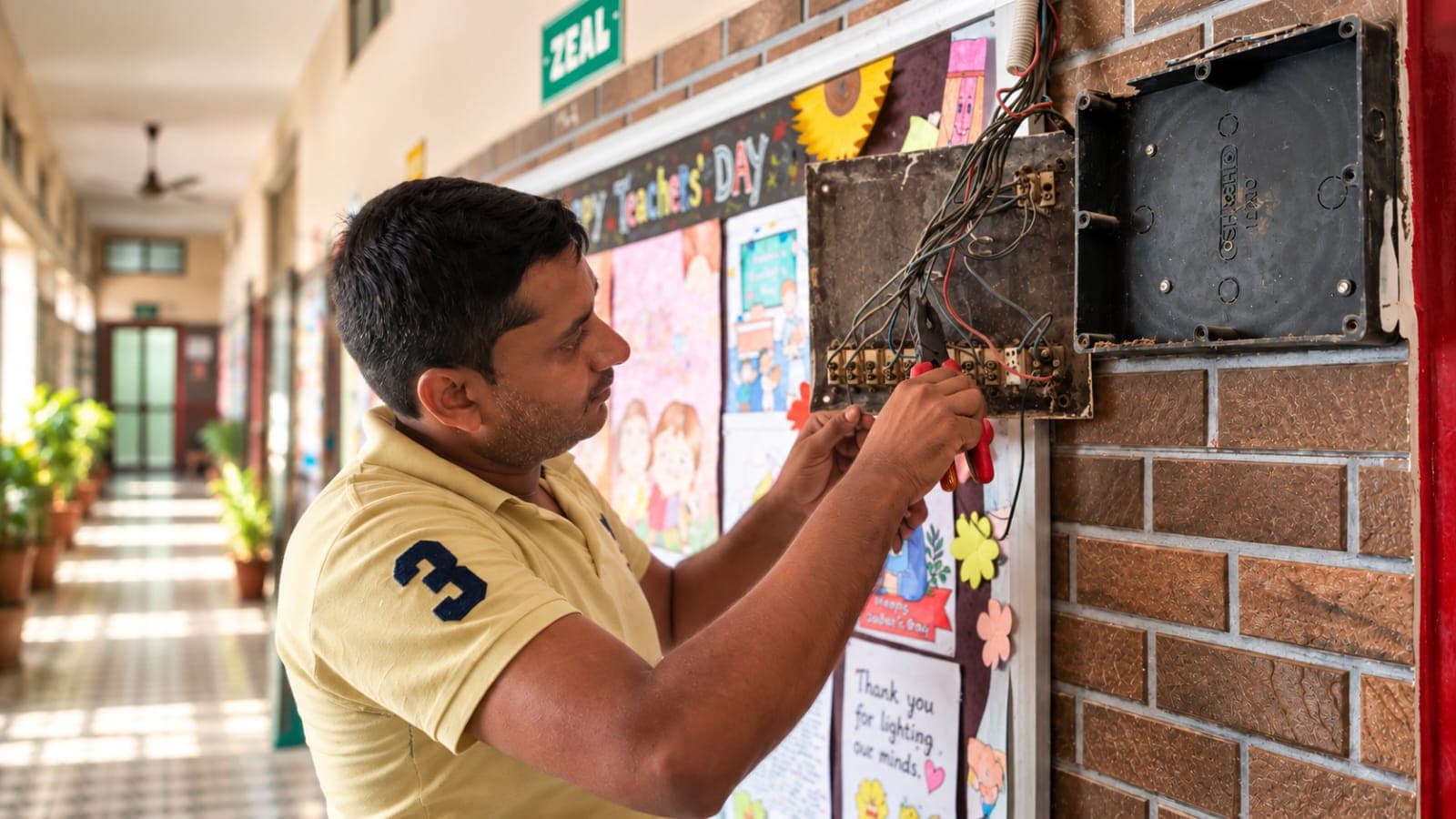
"Mera beta electrician nahi banega,” said a parent with conviction bordering on anger.
I immediately stopped talking. My principal looked at me in the manner that I had by now gotten very familiar with. Coming back to Ayodhya after spending most of my adult life running away from it was not easy. I repeatedly got to hear that you don’t get how things work here. I didn’t contest that claim, but I strongly believed that leaving gives you perspective and, in my case, a dogged persistence and refusal to normalise things just because they are widely practised.
I was talking to a mother who refused to accept that her 15-year-old son was performing way below his grade level in reading and arithmetic. This was after a year of continuous efforts by teachers in remedial classes. I brought up vocational education.
The conversation didn’t go well.
The mother wanted personal time with me because she had heard I went outside India to do my master’s. She believed that I should have acquired some magical skills that we don’t have in India to get her child into the IITs.
This is the story of a lot of first-generation learners in India. This boy was the first child in his family to go to an English-medium school. His dad worked in the Gulf in the informal sector so he could send his child to a good English-medium school in his hometown. In my school in Ayodhya, I have a lot of children coming from families like the one I have described.
This particular conversation stayed with me because the mother, once her initial anger subsided, sobbed and said, “We have sacrificed so much not to make my child an electrician.”
I always pay attention to intense emotions, both in myself and in others, because I believe they are a window into ourselves.
I talked to my father about it. I talked to my electrician and carpenter about it. No one wanted their children to be carpenters or electricians, even if they made enough money.
It wasn’t about money.
One person said, “Why do you call me ‘bhaiya’ but your teachers ‘sir’?”
In India, we have created layers of modernity that still sit on traditional beliefs like the caste system, where the highest rung is occupied by those who do cerebral work. Most of us aspire to be doctors and engineers so we can eventually become bureaucrats. It is one of the quickest ways to secure respectability and status.
We are sitting in an age of AI where many skills of the mind are becoming easier to replace than those of the hand, but our aspirations don’t know that.
And more than our aspirations, our social structures are still deeply shaped by the belief that those who work with their hands are somehow “unskilled” or “low-skilled”.
Most vocational education programmes struggle not only because of design or implementation, but because caste and class continue to shape what kinds of work we consider respectable.
This is also why the current pivot towards vocational education under Samagra Shiksha matters.
Its value cannot lie merely in adding another subject to the timetable. The real opportunity is to create space inside schools for children to encounter a different imagination of work.
Schools quietly teach children what to aspire to. They notice who is called “sir” and who is called “bhaiya”. They notice whose knowledge is treated as expertise and whose work becomes visible only when something breaks. They absorb these hierarchies long before they enter the labour market.
Vocational education, then, cannot simply mean teaching a child how to wire a circuit, repair a machine, grow food or build something with their hands. It also has to change the social meaning attached to those skills.
Schools can help do this by bringing skilled workers, craftspeople, technicians and entrepreneurs into learning spaces as people with expertise, by giving children real exposure to different forms of work, and by creating visible pathways from vocational skills to certification, apprenticeships, further education and entrepreneurship.
But curriculum alone cannot change aspiration.
Parents will not suddenly value skilled work if it continues to offer poor wages, weak progression and low social status. If vocational education is to become genuinely aspirational, skills of the hand must lead to real economic mobility and command dignity in the labour market.
I tell everyone who cares to listen that the guy who cleaned my dorm in Switzerland drove a Mercedes. I know we are far from that. But the point was never the Mercedes. It was what it represented: that the work someone did did not automatically determine the respect they were entitled to.
AI may eventually force us to reconsider why the hard work that goes into cracking the civil services examination is considered superior to the hard work that goes into building a road, fixing an electrical system or keeping a city functioning.
But perhaps we don’t have to wait for technology to force that reckoning upon us.
Samagra Shiksha gives schools an opening to begin that work now: not simply by putting vocational education on the timetable, but by changing whose knowledge we value, what kinds of work children learn to respect, and whether skills of the hand can become a credible route to mobility.
Perhaps the task is not simply to convince a mother that there is nothing wrong with her son becoming an electrician.
The harder task is to build a society in which becoming a very good electrician is something she can imagine wanting for him.