
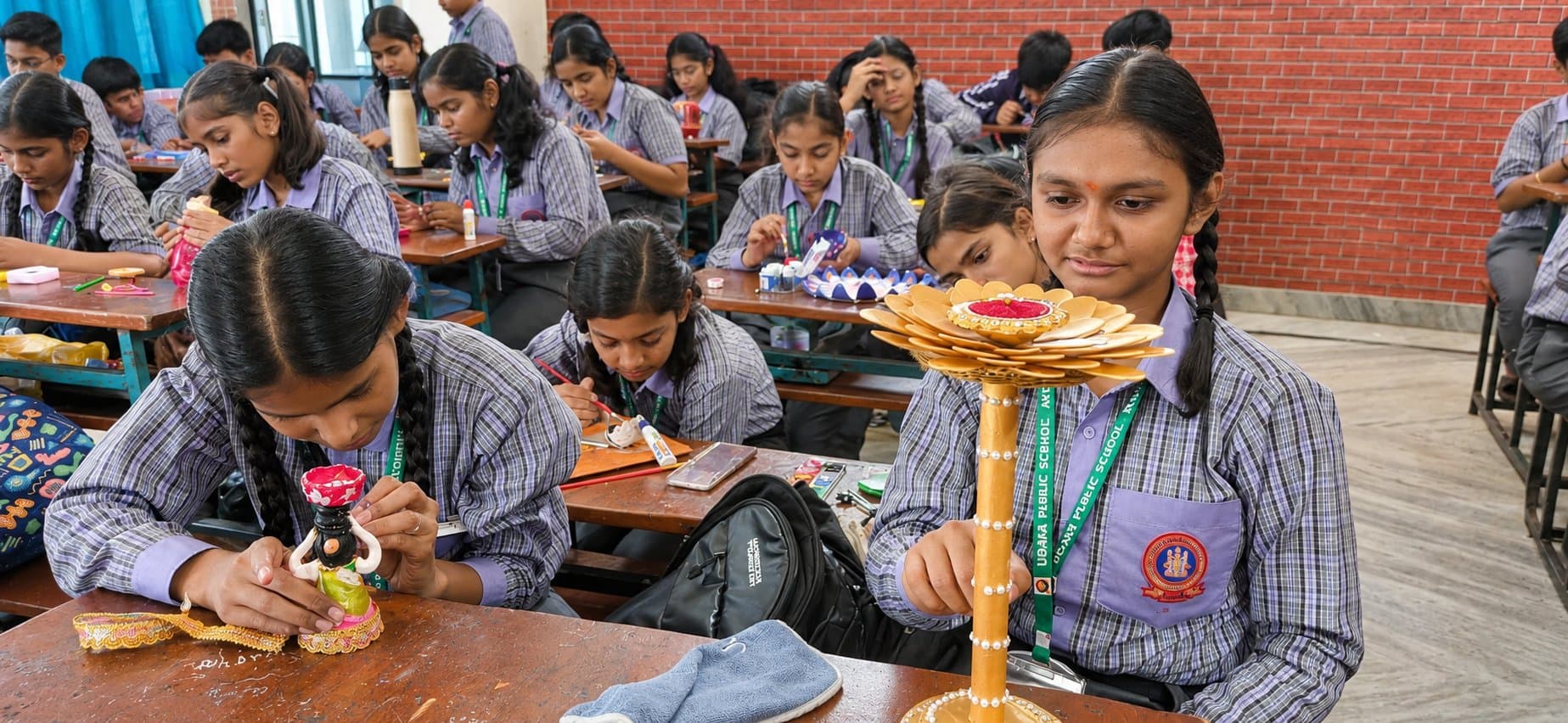
Every year, in the days just before Diwali, Udaya Public School sets aside a morning that belongs entirely to the students. No textbooks, no timetable. Just clay diyas, colour and the kind of quiet focus that comes when a child is working on something that matters to them.
This is our annual Diya Making Competition, and it has become one of the moments the school looks forward to most.
A Morning That Begins with a Plain Clay Diya
Each student arrives with a simple, undecorated clay diya. What happens next is entirely up to them.
Some reach for poster colours and work with careful, deliberate brushstrokes. Others bring small mirrors, beads, threads or flowers from home — adding texture and dimension that makes each diya wholly their own. No two are alike, and that is the point.
The competition runs in two formats. Students who prefer to work alone participate in the individual category, taking their time over each detail. Those who choose the group format work together in small teams, negotiating colour palettes and dividing tasks — a small exercise in collaboration that asks them to listen as much as they create.
Across both categories, the school fills with the kind of productive quiet that is different from the quiet of an examination. This is concentration in its most willing form.
Why This Activity Belongs in School
It is easy to see a diya decorating competition as a holiday celebration and nothing more. But at Udaya, we have come to understand it as something with a wider purpose, one that connects naturally to what we try to do through our beyond-academics programme all year.
When a student picks up a brush and decides how to decorate their diya, they are making dozens of small decisions. What colour? In what order? What if it doesn't look the way I imagined? These are not small questions for a child. They are early exercises in creative judgement, in patience and in the willingness to begin even without certainty about the outcome.
Working in groups adds another layer. Teams must agree, adjust and sometimes step back from their own preferences to make room for someone else's idea. These are the same skills we hope students carry into classrooms, conversations and eventually into their working lives.
The beyond-academics strand at Udaya exists precisely because we believe school should develop the whole person, not only the student who can answer questions correctly. Activities like this one are not supplements to education — they are part of it.
A Tradition That Repeats Because It Works
Some school activities are tried once and quietly forgotten. This one has stayed.
Year after year, teachers who help organise the morning notice the same things. Students who are quieter in class often come forward here. Children who struggle with written work find a different kind of confidence when they are holding a brush instead of a pen. The festival context also gives the activity a natural warmth — there is something about decorating a diya that connects children to something larger than the school day.
Parents who collect their children in the afternoon see the diyas come home. Families light them on the night of Diwali. What began as a school competition ends as a small shared ritual, made by a child's own hands.
For us, that is exactly the kind of beyond-academics moment worth protecting each year — one that sits quietly between the academic calendar's larger events, and yet leaves something lasting behind.