For generations of families across Uttar Pradesh, conversations about career choice followed a narrow and predictable track. A student completed Class 10, picked a stream, and aimed towards one of three or four established destinations: clinical medicine, civil engineering, chartered accountancy, or government administrative services. In Ayodhya today, high school students encounter a professional landscape that looks markedly different. At Udaya Public School, we see senior students grappling with an unprecedented variety of undergraduate degrees, emerging professional fields, and hybrid industries. Helping teenagers make sense of these possibilities requires moving away from outdated assumptions and approaching career planning with structured curiosity.
Looking Beyond the Narrow Horizon
The traditional pressure to commit to a single lifelong career at age fifteen or sixteen creates unnecessary anxiety. Many students assume that if they do not know their exact profession before finishing school, they are already falling behind.
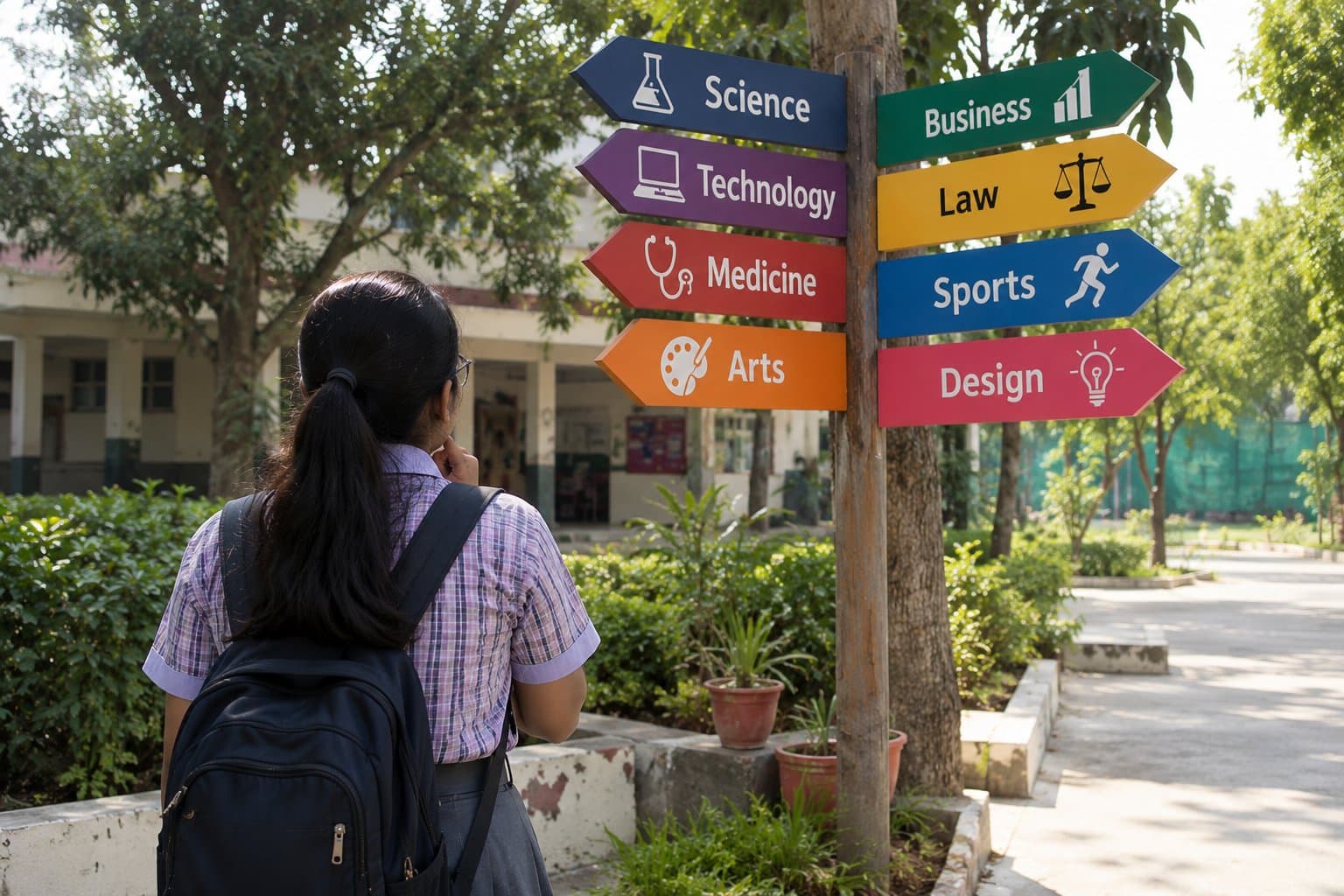
In reality, the modern economy rewards adaptability far more than premature specialisation. Technology, international commerce, and public governance are creating hybrid occupations that did not exist a decade ago. A student interested in healthcare might pursue health informatics or bioinformatics rather than clinical surgery. A student fascinated by language and law might work in intellectual property rights, data privacy compliance, or regulatory policy. When families treat career selection as an all-or-nothing choice between a few prestigious streams, they overlook dynamic sectors where young graduates build purposeful and financially rewarding work.
Developing Competencies Instead of Job Titles
Rather than asking a student what title they want on their business card at thirty, a more productive approach is to evaluate what kinds of problems they enjoy solving.
Career planning becomes clearer when broken down into foundational competencies:
- Analytical and numerical reasoning: comfort with quantitative data, structured logic, and mathematical modelling.
- Verbal clarity and synthesis: the capacity to digest complex information, construct reasoned arguments, and articulate ideas clearly.
- Creative and spatial thinking: designing visual concepts, understanding physical systems, and developing original solutions.
- Collaborative leadership and empathy: coordinating teams, understanding human motivation, and managing community initiatives.
A student who develops two or three of these competencies thoroughly will remain agile and capable, regardless of how specific job titles evolve in the decades ahead.
The Rise of Multidisciplinary Higher Education
The structure of higher education in India has evolved substantially. Under modern university frameworks and national testing mechanisms such as the CUET, undergraduate programmes increasingly encourage students to combine major and minor subjects across traditional faculty divisions.
A student pursuing economics can now study data science alongside it. A humanities student can take courses in public policy, statistics, or environmental sustainability. This structural flexibility means that school students no longer need to worry about being permanently defined by a single early decision. The senior secondary curriculum at Udaya Public School, anchored in our rigorous academics programme, provides the academic depth required to qualify for selective university courses while preserving broad intellectual horizons.
Practical Discovery Through School Life
A genuine vocational interest is rarely uncovered by sitting quietly with a textbook. Students learn what kind of work suits them by testing their abilities in real contexts.
Participating in debate competitions teaches a teenager whether they relish structured advocacy and public dialogue. Organising house events or contributing to student publications reveals whether they enjoy editorial deadlines and project coordination. Regular involvement in physical education develops team communication and composure under pressure. Through our beyond-academics initiatives, including community outreach, creative arts, and subject clubs, students gain direct experience that clarifies their strengths long before they complete university applications.
How Families Can Support the Conversation
Parents play an indispensable role in helping children evaluate future possibilities without adding unhelpful pressure. Several straightforward approaches help keep family discussions constructive:
First, listen before advising. Teenagers often show interest in emerging disciplines such as design, sports management, or environmental economics. Rather than dismissing unfamiliar options, parents can encourage the student to research actual degree requirements, professional bodies, and career trajectories.
Second, separate family expectations from the student's individual aptitude. Encouraging a teenager into an ill-fitting field to satisfy external expectations frequently leads to academic fatigue and diminished self-confidence.
Third, connect with people working across different sectors. Speaking with relatives, mentors, and professionals in varied roles helps demystify daily working life and dispels popular myths surrounding specific careers.
Planning Ahead with Deliberate Calm
Choosing a career is not a single, irreversible decree made on the day board examination results arrive. It is an ongoing process of gathering reliable information, understanding personal strengths, and matching interests with real economic opportunities.
At Udaya Public School, our teachers and coordinators work closely with students throughout Classes 9 to 12 to provide grounded perspective, academic mentorship, and realistic guidance. Families seeking advice on subject combinations, higher study options, or senior secondary admissions are always welcome to contact the school office to arrange a consultation. Approaching this milestone with calm preparation ensures that students step forward into their future with purpose and quiet self-assurance.