At Udaya Public School, Ayodhya, heritage education is becoming more than a lesson about the past. It is becoming a way for students to understand the place they call home.
What does heritage mean to a young student?
It could be a monument they pass every day but have never explored closely. It could be a traditional dish prepared at home, a word used by a grandparent, a folk song, a traditional craft, a neighbourhood story—or the river that has been part of the life of their city for generations.
At Udaya Public School, Ayodhya, students are being encouraged to look at heritage not as something distant or confined to history books, but as something living around them.
The school's approach brings together heritage programmes, hands-on activities, local exploration, documentation, filmmaking, traditional crafts, food, language and conversations across generations. The aim is simple: to help students experience, explore, document, share and ultimately care for the heritage of Ayodhya and the wider Awadh-Purvanchal region.
From Seeing Heritage to Experiencing It
Heritage education often begins with knowing names, dates and historical facts. But meaningful understanding begins when students get an opportunity to experience what they are learning.
At Udaya Public School, heritage learning is being developed as an ongoing part of student life rather than a collection of one-time events. Students encounter heritage through monuments, rivers, food, language, crafts, stories, filmmaking and conversations with older generations.
The school's association with the INTACH Ayodhya Chapter, participation in heritage programmes, workshops and competitions, and regular engagement with initiatives such as Saryu Yuva Vandan have created opportunities for students to step beyond the classroom and engage directly with their surroundings.
This year, the school has taken another step forward with the formal establishment of a Heritage Club, providing students with a structured platform for sustained exploration and documentation of their city's heritage. Approximately 30–35 students have currently been shortlisted as student volunteers.
A Heritage Club Led by Curiosity
The Heritage Club is designed to gradually move students from participation to student-led exploration. The process begins with orientation—understanding what heritage is and why it matters. Students then explore a theme, document their observations, visit sites where possible, and reflect on what they have discovered.
The first theme focuses on Ayodhya's built heritage, particularly monuments and structures that may be lesser-known, under-documented or not commonly encountered by students. Each student is being assigned a built heritage site and encouraged to explore its history, present condition and significance through observations, photographs and notes
The documentation process itself is deliberately simple: identify the site, explore its past, observe the present, visit and document, and finally reflect on what has been discovered. Students are encouraged to record not only what they see, but also the questions that arise and what they believe should be protected. This transforms a student from a passive visitor into an observer, researcher and storyteller.
Heritage Is Also Found at Home
One of the most meaningful aspects of heritage education is recognising that heritage does not always have to be found inside a monument.
Sometimes, it is sitting in the kitchen.
The school's weekly cooking activities have become an entry point into local food heritage. During the Heritage Club orientation, students discovered that some traditional foods from Awadh and Purvanchal were unfamiliar even to them. This led to sessions where students not only learned how to prepare traditional dishes but also explored their local context and history. Recent sessions have included Chawal ka Fara and Ragda Chaat.
Language offers another window into cultural memory.
Through the Heritage Connect holiday activity, students spoke with elders and collected older Hindi, Urdu and Awadhi words that are no longer commonly used. For older students, these conversations also opened up questions about how Ayodhya was in the past, what has changed and what deserves to be protected.
In this way, a conversation with a grandparent can become a history lesson—and a family recipe can become a doorway into cultural memory.
Learning Through Doing
The programme places strong emphasis on experiential learning.
Students are encouraged to visit places, learn skills, make traditional objects, create films and document what they encounter. Through FilmIt India, students receive opportunities to learn filmmaking and documentary-making in Varanasi and apply those skills to local heritage subjects. Previous student films have explored subjects such as Nirmohi Akhara, Kumhar Para and the Satalla dish.
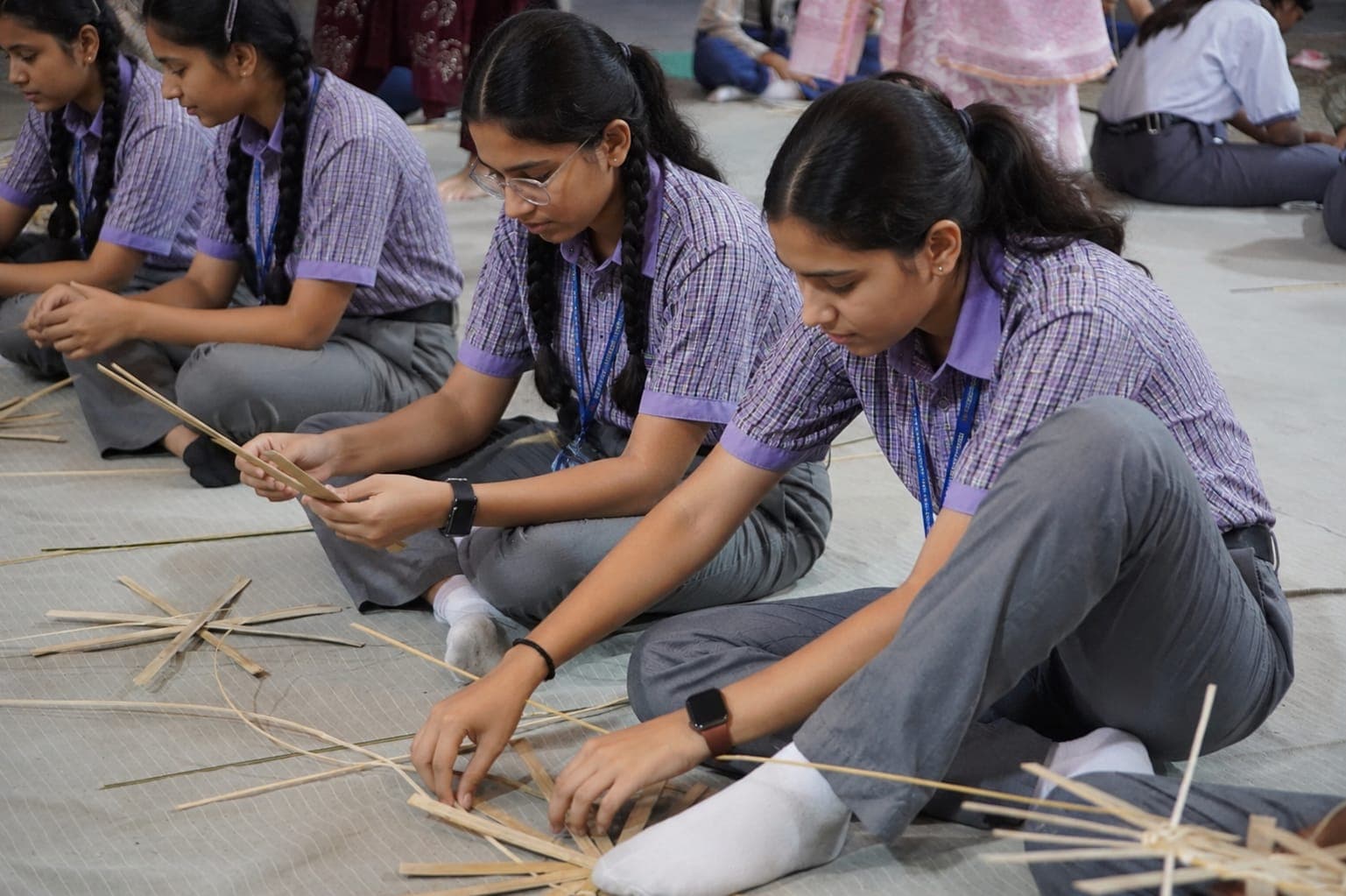
Traditional craft workshops offer another kind of learning. A recent basket-weaving workshop introduced students to traditional basket-making and gave them the opportunity to make baskets and dolchi themselves. The experience is important because students are not simply told that a traditional craft is valuable—they get to understand the skill, material and effort involved in creating it.
Every Age Can Explore Heritage
Heritage learning is being adapted to different age groups.
For younger students in Classes I–III, exploration begins with old objects at home, family stories and observations during walks around Ayodhya. Classes IV–V explore heritage through photographs, sketches, traditional food and older Hindi, Urdu and Awadhi words. Students in Classes VI–VIII engage with heritage postcards, creative responses and an introduction to INTACH's work, while Classes IX–X explore local heritage concerns and speak with elders about change and protection.
This age-appropriate approach allows heritage to grow with the student—from curiosity and observation to research, reflection and responsibility.
From Participation to Documentation
A key next step is to ensure that these experiences do not disappear after an activity ends.
The Heritage Club's implementation plan includes records of membership, attendance, an annual activity calendar, activity reports, photographs, certificates and achievements. Over time, these records will form an evolving Heritage Club portfolio reflecting what students have observed, created and contributed.
This documentation gives student experiences a longer life. A field visit becomes a record. A conversation becomes an oral-history resource. A photograph becomes evidence of change. A student's reflection becomes part of the story of the city.
Heritage as Part of Learning
The goal is not to turn heritage into another academic responsibility. Instead, students are encouraged to discover how naturally heritage connects with what they already learn at school. A visit to a monument can open conversations about history and architecture, while an old or disappearing word can lead to an exploration of language and cultural memory. Traditional food can help students understand the connection between family, geography and culture, while the river can become a starting point for thinking about the local environment. Similarly, creating a documentary brings together research, storytelling and communication.
This is where heritage education becomes especially meaningful: the city itself becomes a learning environment, and everyday experiences become opportunities to learn.
Building a Relationship with the Place We Call Home
The ultimate purpose of the Heritage Club is not simply to produce reports, photographs or activities. It is to nurture a relationship between students and their surroundings. The school hopes that students will begin to recognise heritage in the ordinary things around them—a monument they pass, a dish prepared at home, a word spoken by a grandparent, a traditional craft, a neighbourhood story or the river flowing through their city.
When students begin to notice these things, they begin to ask questions. When they ask questions, they begin to explore. As they document what they discover, they begin to preserve memories, and when they share their learning with others, they become part of carrying that heritage forward.
Experience. Explore. Document. Share. Preserve.
This is the journey Udaya Public School is creating through its Heritage Education & Engagement initiative, a journey in which students do not simply learn about Ayodhya's heritage, but gradually become active participants in understanding and caring for it.